On December 9 in Ha Noi, the Australian Trade and Investment Commission (Austrade), under the Australian Embassy in Viet Nam, in coordination with Berries Australia, hosted an official event to welcome Australian blueberries to the Vietnamese market.
Speaking at the event, Christopher Morley, Australia’s Trade and Investment Counsellor, described this as an important milestone reflecting the long-standing and close cooperation between Viet Nam and Australia in the agricultural sector. He noted that the approval for Australian blueberries to be officially exported to Viet Nam is clear evidence of the trust, strong ties, and continuous development in bilateral trade relations.
Blueberries become the seventh Australian fruit to enter Viet Nam
Echoing Mr. Morley’s remarks, Rachel Mackenzie, Chief Executive Officer of Berries Australia, said: “Blueberries are the seventh Australian fruit to be exported to Viet Nam. This is the result of close and effective cooperation between the governments of the two countries over many years.”
According to Ms. Mackenzie, Australia is currently the only country capable of producing blueberries year-round, thanks to its diverse climatic conditions. This advantage ensures a stable supply for partners, including Viet Nam, even during periods of low global market availability.
Blueberries are also among the premium fruits highly favored by Australian consumers. Benefiting from high-quality soils, diverse climates, advanced farming techniques, strong investment in varietal research, and a stringent biosecurity system, Australia’s blueberry industry consistently maintains top-tier quality. Statistics show that 65% of Australian households consume blueberries regularly each year.
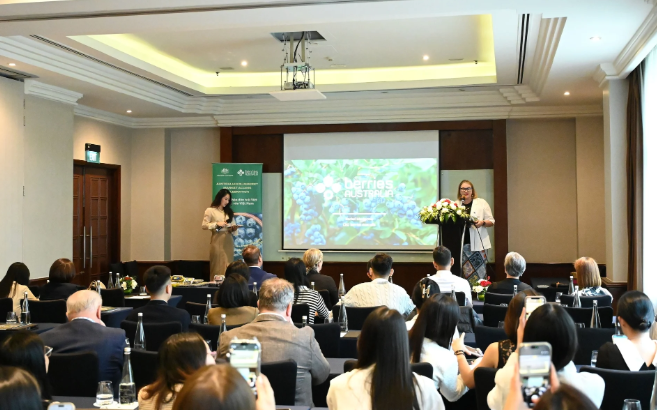 A representative of Berries Australia shares insights on blueberry quality and market prospects at the event welcoming Australian blueberries to Viet Nam on December 9. Photo: Kieu Chi.
Viet Nam as a strategic growth market
For Australia, Viet Nam is regarded as a new strategic market, with exporters expecting revenues of USD 2.65 million in the first year, rising to USD 14.6 million over the next five years. Geographic proximity to Viet Nam and other Southeast Asian countries allows Australian blueberries to retain their freshness within just 24 hours after harvest, ensuring high quality when they reach consumers.
Ms. Mackenzie noted that Australian blueberry varieties are currently grown in at least 40 countries worldwide. However, the majority of production is still destined for the domestic market in the form of fresh fruit. In the 2024 financial year, only 4% of Australia’s total blueberry output was exported, although this figure doubled compared to the previous year, reflecting a strong commitment to expanding international markets for the product.
“Even in the highly competitive domestic market for premium products, blueberry consumption continues to grow each year. During periods of economic downturn, when households tend to cut spending on high-end items, expenditure on blueberries has not declined. This highlights the fruit’s strong and enduring appeal among consumers,” Ms. Mackenzie emphasized.
Currently, according to Berries Australia, Hong Kong is the largest export market for Australian blueberries, accounting for around 50% of total export volume. Australian growers are optimistic that Viet Nam will emerge as a new high-potential market. To meet Vietnamese consumer demand, growers have indicated their readiness to scale up production and increase export volumes beyond the current 4% level.
A global leader in blueberry technology and varieties
Elaborating on Australia’s berry industry, Ms. Mackenzie noted that in recent years, blueberry production in Australia has made remarkable advances thanks to the application of modern technologies such as substrate cultivation, protected cultivation in greenhouses and net houses. These methods help reduce pest pressure while increasing productivity on the same land area.
Australia also widely applies beneficial organisms in cultivation, combined with natural pollination by bees and integrated pest management systems, ensuring a stringent biosecurity production process. The country is regarded as one of the world’s leaders in plant genetic research, particularly in blueberry varieties.
Thanks to its diverse climatic zones, Australian growers are able to invest in blueberry production across multiple regions with varying levels of chilling requirements, ranging from no chill to low, medium, and high chill. This enables consistent varietal quality and a wide diversity of blueberry types nationwide.
Typically, it takes 7–10 years to successfully develop a new commercial blueberry variety. Therefore, Australia places strong emphasis on genetic research and development programs to ensure a continuous pipeline of new varieties that can adapt to climate change while optimizing yields under different soil conditions and farm sizes. At the same time, new varieties are also improved in sweetness and crunch, with the goal of delivering the highest possible quality to consumers.
Beyond varietal leadership, Australia is also among the most advanced countries in blueberry packaging and post-harvest handling technologies. Currently, blueberry packing and processing speeds in Australia can reach up to one tonne per hour, supported by modern machinery capable of sorting fruit by size, firmness, and overall quality.
Notably, forced-air cooling systems are applied directly at harvest sites, allowing the fruit temperature to be rapidly reduced immediately after picking. This ensures that blueberries reach optimal storage temperatures before transportation to the market. As a result, products delivered to consumers consistently retain their freshness, natural flavor, and premium quality.
Earlier, the first shipment of fresh Australian blueberries arrived at a Vietnamese port on December 5, imported by Anh Minh Fruits Company, just two months after the market was officially opened in October. This is regarded as an important step forward in agricultural trade cooperation between the two countries, while further reaffirming Australia’s position as one of the world’s leading suppliers of premium fruit.