The Law amending and supplementing a number of articles of 15 laws in the agriculture and environment sector, comprising 17 articles, was passed with strong approval from National Assembly deputies. The promulgation of the law aims to institutionalize the Party’s guidelines on reforming organizational structures, decentralization and delegation of authority, simplification of administrative procedures, reduction of business conditions, and timely resolution of practical difficulties arising from management practice.
The law is expected to help unlock resources, support socio-economic development, and meet practical needs in the agriculture and environment sector.
This amendment focuses on three main groups of issues: restructuring organizational apparatuses; reforming administrative procedures and investment and business conditions; and addressing bottlenecks that are “ripe and clear” for resolution.
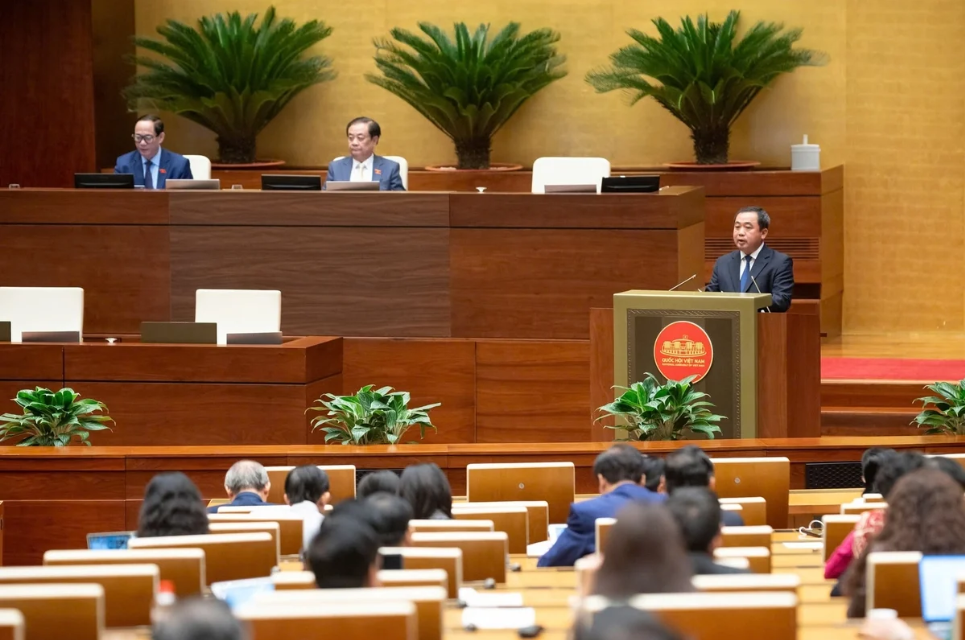 The National Assembly votes to pass the Law amending and supplementing a number of articles of 15 laws in the agriculture and environment sector.
On the morning of December 11, with a majority of deputies voting in favor, the National Assembly passed the Law amending and supplementing a number of articles of the Law on Geology and Minerals. The National Assembly also heard Minister Tran Duc Thang, authorized by the Prime Minister, present the Report on explanation, acceptance, and revision of the draft Law amending and supplementing a number of articles of the Law on Geology and Minerals.
According to the Minister, the Government has incorporated feedback and worked with relevant agencies to review, revise, and finalize the draft, ensuring the consistency and coherence of the legal system, providing clear provisions on transitional cases, and addressing several other specific issues.
The draft Law introduces stringent mechanisms for the management of rare earths, based on the principle that strategic and development-oriented matters will be decided by the Government. Technical details and specific tasks will be stipulated in subordinate legal documents, with appropriate authority delegated to ministries, sectors, and localities. In addition, the drafting body revised the general provisions on rare earth management with the objective that exploration, extraction, and processing must go hand in hand with the formation of closed value chains, in order to avoid exporting raw materials. The Law also emphasizes the use of modern, low-emission extraction and processing technologies, and reaffirms the Government’s unified management role in guiding the exploration and exploitation of minerals, including rare earths.
The amended Law contributes to completing the legal framework for geology and minerals, as well as for national reserves.
On the morning of December 11, the National Assembly passed a Resolution on addressing difficulties and obstacles in the implementation of the Land Law, with 428 out of 437 deputies present voting in favor (accounting for 90.49% of the total number of deputies). The Resolution introduces 17 new provisions aimed at removing bottlenecks in the enforcement of the Land Law.
Accordingly, the National Assembly agreed to reduce by 70% the land-use conversion fee when agricultural land is converted to residential land. Specifically, land users will only be required to pay 30% of the price difference when converting agricultural land to residential land, instead of 100% as currently applied. The Resolution also adds three additional cases in which the State is entitled to recover land, including provisions allowing the State to recover land for projects where agreements have been reached for more than 75% of the land area.
The National Assembly also approved the investment policy for the National Target Program for the 2026–2035 period. The integration of three national target programs will not cause disruptions or policy gaps, with the highest priority given to the development of ethnic minority and mountainous areas. Under the National Target Program on New Rural Development and Socio-economic Development in Ethnic Minority Areas for 2026–2035, the goal is to reduce the multidimensional poverty rate among ethnic minority households to below 10%.