Recently, Hanoi University of Civil Engineering, in collaboration with the Utrecht Urban Research Institute (the Netherlands), organized a seminar titled "The Netherlands’ approaches to climate change mitigation and adaptation, and urban resilience - the case of Rotterdam."
In her opening remarks, Assoc. Prof. Dr. Ta Quynh Hoa, Head of the International Training Faculty and Director of the Center for International Training Cooperation and Consultancy (Hanoi University of Civil Engineering), emphasized that Viet Nam is considered one of the countries most vulnerable to climate change, facing increasingly severe challenges such as sea-level rise and extreme weather events.
In this context, learning from international experience, particularly from countries with strong expertise in water management and urban planning like the Netherlands, is of great importance.
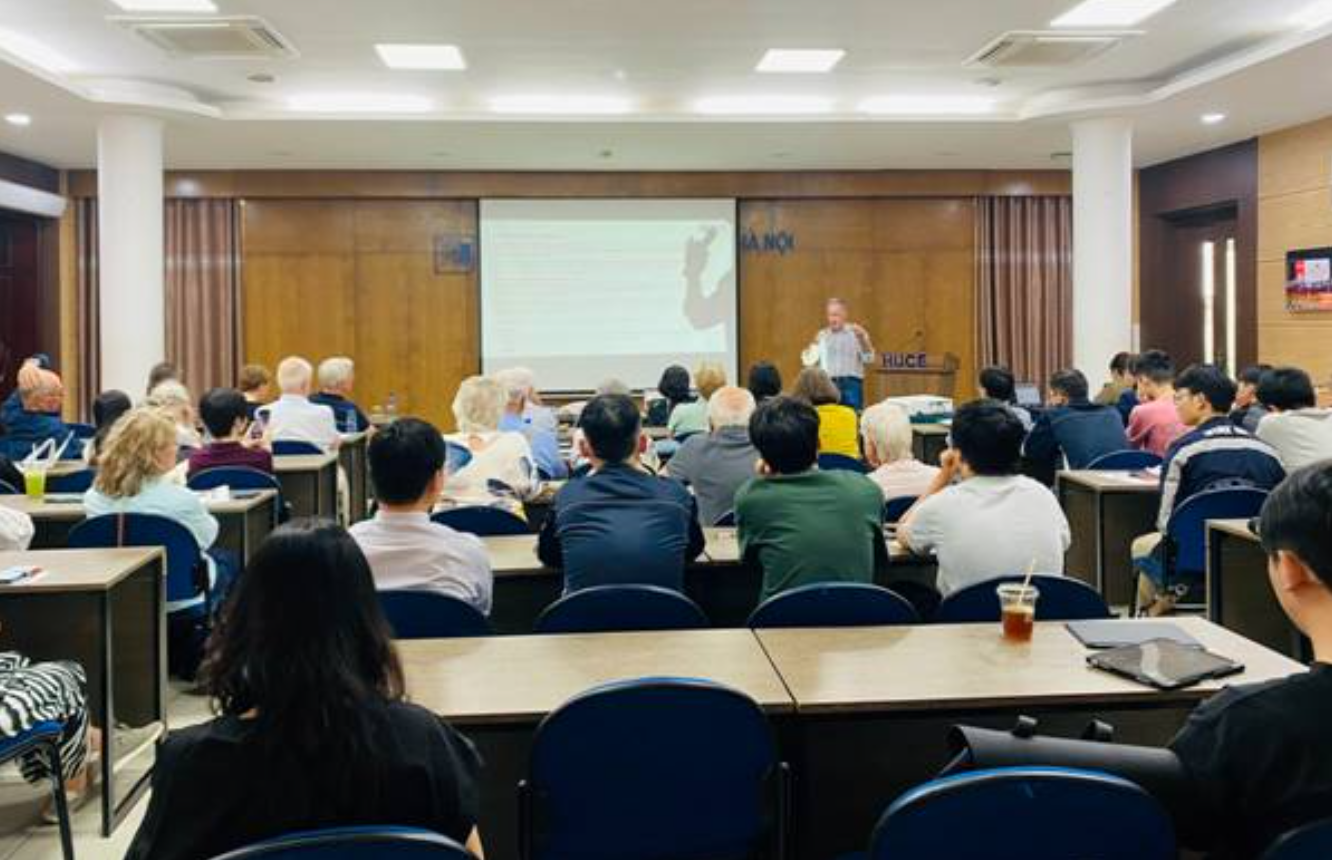 Overview of the seminar. Photo: Hanoi University of Civil Engineering.
With the participation of experts from the Utrecht Urban Research Institute (the Netherlands), the seminar provided insights into enhancing urban resilience and effectively responding to climate change.
"This will serve as a foundation for advancing academic exchange while also inspiring practical and innovative solutions suited to Viet Nam’s context," Assoc. Prof. Dr. Ta Quynh Hoa noted.
Speaking at the seminar on climate change mitigation, Dr. Leo Van Groesbencho shared that the Netherlands is actively implementing both national and international commitments, aiming to reduce greenhouse gas emissions by 55% by 2030 (compared to 1990 levels), cut emissions by up to 90% by 2040, and achieve climate neutrality by 2050. These efforts are complemented by carbon capture and storage solutions in depleted gas fields and construction materials.
In terms of adaptation, the Netherlands is promoting a "sponge city" approach, enhancing water absorption and regulation capacity through a range of measures such as expanding green and water spaces, integrating technical infrastructure like water storage systems, infiltration systems, and separating rainwater from wastewater. Proactive groundwater management is also considered a key factor.
Dr. Leo Van Groesbencho emphasized that the adaptation strategy of Rotterdam is regarded as one of the most advanced models in the world. Given its location below sea level, the city treats climate adaptation as a core principle in spatial planning.
A wide range of solutions has been implemented in an integrated manner, from "gray" infrastructure such as dikes and storm surge barriers to "blue-green" infrastructure, including water squares, green roofs, and the replacement of concrete surfaces with permeable materials.
Adaptive architectural models such as floating houses and amphibious housing, along with financial support mechanisms for residents, public-private partnerships, and multi-level governance, have further enhanced implementation effectiveness.
Experts from the Utrecht Urban Research Institute also highlighted that climate change adaptation is not only a challenge but also an economic opportunity, particularly through the export of technologies and the development of sustainable urban branding.
The seminar is expected to contribute to promoting climate-adaptive urban planning solutions, moving toward sustainable development and strengthening the resilience of Vietnamese cities amid increasingly complex climate challenges.