On July 10, the Department of Environment under the Ministry of Agriculture and Environment convened a workshop in Đong Nai to discuss the implementation of solid waste management and Extended Producer Responsibility (EPR) regulations.
In his opening remarks, Mr. Nguyen Hung Thinh, Deputy Director General of the Department of Environment, emphasized that the Government has issued various decrees and circulars to operationalize the 2020 Law on Environmental Protection, establishing a legal framework for EPR. This policy mandates that producers and importers are responsible for recycling or treating waste from the products and packaging they introduce to the market.
However, Mr. Thinh acknowledged that EPR remains a new and complex policy involving multiple stakeholders, making it difficult to access and apply. He noted that scattered regulations across different legal documents—such as Decree No. 08/2022/NĐ-CP and the draft Decree No. 05/2025/NĐ-CP—have created confusion for businesses trying to comply consistently.
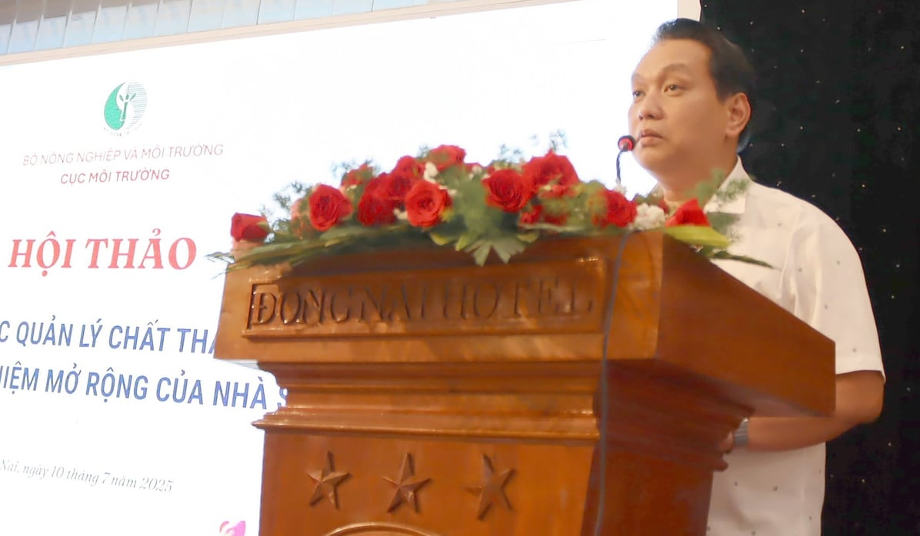 Dr. Nguyen Hung Thinh, Deputy Director General of the Department of Environment under the Ministry of Agriculture and Environment, delivers the opening remarks at the workshop.
To address these challenges, the Ministry has proposed a standalone EPR decree aimed at simplifying, harmonizing, and improving the effectiveness of implementation. The new regulation also aligns with the government’s broader goals for administrative reform, decentralization, and investment environment improvement.
During the workshop, representatives from the Department of Environment provided technical guidance on solid waste classification and treatment models for both urban and rural areas, in accordance with the 2020 environmental law. They also offered detailed instructions on how businesses should fulfill their recycling and waste treatment obligations.
The workshop introduced the draft EPR decree, which outlines specific targets, timelines, recycling quotas, and implementation mechanisms. It also includes provisions on financial contributions, registration procedures, and mandatory reporting. These elements drew strong interest and feedback from participants.
In his closing remarks, Mr. Thinh stressed that all comments from the workshop will be carefully considered in finalizing the decree. He reiterated the government's commitment to improving the national solid waste management system and ensuring that EPR is implemented in a consistent and effective manner across the country.