Climate change is increasing water scarcity in the Mekong Delta, putting livelihoods and local communities at greater risk.
The report “Unlocking the Role of Social Protection: Promoting Climate-Resilient Livelihoods in Viet Nam - Water Scarcity and Income Security in the Mekong Basin” by the International Labour Organization (ILO) analyzes options for adjusting the social protection system to strengthen resilience against the growing impacts of climate change-induced water scarcity on people’s livelihoods.
Mekong Delta faces severe impacts
The report highlights that the Mekong Delta - the backbone of Viet Nam’s agriculture - supplies around 50% of the country’s rice output, 95% of rice exports, 60% of seafood exports, and 70% of fruit production, while contributing about one-third of agricultural GDP. However, the region is facing increasingly severe impacts from climate change.
Sea level rise is intensifying saltwater intrusion, while tropical storms, floods, droughts, and riverbank and coastal erosion continue to cause major damage to land and local livelihoods. These impacts are further exacerbated by hydropower development upstream along the Mekong River, which alters water flows and water quality. As most of the Mekong River’s water originates outside Viet Nam’s territory, water resource management depends heavily on international cooperation.
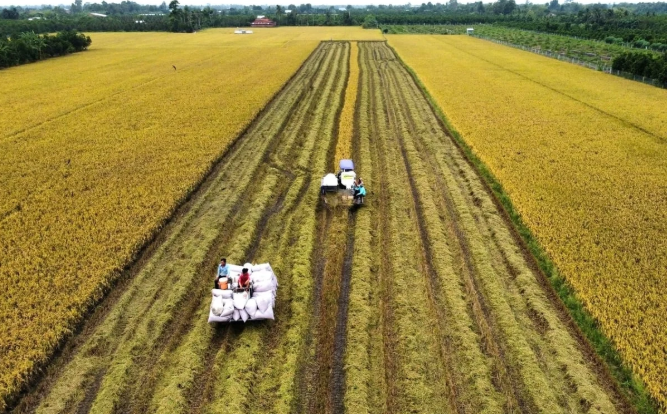 The Mekong Delta is one of the country’s key food production hubs, but it is increasingly affected by climate change. Photo: VAN.
In response to these challenges, Viet Nam has shifted away from intensive rice cultivation toward more sustainable adaptation strategies, as reflected in the Mekong Delta Master Plan and Resolution No. 120/NQ-CP dated November 17, 2017, which promotes flood-adaptive agriculture and integrated water resource management.
However, projections continue to show significant risks. Under a one-meter sea level rise scenario, around 75% of the Mekong Delta could be submerged, with more than 12 million people at risk of displacement by 2050. Saltwater intrusion is shrinking arable land, forcing many farmers to switch to aquaculture, though this sector also faces high risks from salinity fluctuations, disease outbreaks, and damage caused by extreme weather events.
As agricultural productivity declines and food prices fluctuate, poor households are among the hardest hit. With a population of more than 20 million, the Mekong Delta is facing mounting pressure from poverty and migration as environmental degradation and climate risks become increasingly severe.
Promoting an “adaptive social protection” system
Against this backdrop, Viet Nam’s social protection system - including social insurance, health insurance, social assistance, and employment policies - is identified as an important tool for strengthening resilience to climate risks. Social protection coverage has expanded significantly, but major gaps remain for agricultural and informal-sector workers, who are among the groups most vulnerable to water scarcity and climate change.
Analyses show that social protection plays an important role in both short-term response and long-term adaptation. In the short term, the system helps stabilize incomes, reduce healthcare costs through health insurance, and provide emergency support during droughts, floods, or saltwater intrusion events. In the long term, social protection supports workers in transitioning livelihoods, diversifying income sources, and improving their ability to adapt to changing climate conditions.
However, the ILO notes that social protection responses to water scarcity remain limited. Many current policies remain largely reactive and short-term, while early warning mechanisms, automatic support activation systems, and links to disaster risk management have not yet been implemented in a coordinated manner. In addition, complex administrative procedures and limited accessibility continue to reduce the effectiveness of support for vulnerable groups.
Surveys conducted in Mekong Basin provinces show that more than 30-40% of households experienced income losses following droughts, while over 20% suffered direct impacts on their livelihoods. Healthcare costs also increased due to water-related illnesses. Although most people had access to information about support policies, the level of social protection benefits received remained lower than that provided by water infrastructure measures.
The ILO recommends that Viet Nam develop “adaptive social protection” as a key pillar of its sustainable development strategy. This system would include expanding social insurance coverage for informal workers, building a basic social protection floor, improving emergency assistance mechanisms, and strengthening links between social protection systems and early warning systems.
Effectively integrating social protection into policy frameworks will play an important role in protecting livelihoods, reducing poverty, and strengthening people’s resilience to the growing risks posed by climate change in Viet Nam.